No Tuna Salad, all plated up and pretty. It would be great as part of a Stuffed Juicy Tomato dish when the tomatoes come out this summer.
Finally! A new permanent addition to my vegan repertoire.
I’m not big on substitutes, so I’ve had a hard time working my way into a vegan diet. I like eggs and cheese, and despite the claims that people can’t tell the difference between vegan cheeses and the “real thing,” I haven’t been successful in making anything remotely satisfactory.
So…I approached this substitute with some doubt: Tuna Salad without tuna? OK.
I have to tell you, though, this was a taste treat. The texture is right. The taste is right. It was really delicious, and I’m salivating for another one as I write this.
The Woodstock Farmers Market fresh tomato helped as did the homemade spelt challah, but as you see from the intro picture, I also enjoyed the chickpea “tuna” all by itself as well, and it was great!
So here’s what I did: I just made “tuna” salad the way I always used to except that I used chickpeas (dried, cooked, drained and slightly mashed) in place of tuna and Just Mayo from Hampton Creek instead of Hellman’s Real Mayonnaise. I want to tell you, Hampton Creek got that Mayo knocked! It’s delicious, and the consistency is just right.
This was so easy to do. I’m looking for vegan things to make that I love and that are really easy. This is the first item I’m going to add to my permanent folder other than my longstanding Middle Eastern favorites that are mostly vegan anyway.
No-Tuna Sandwich on Homemade Spelt Challah
Ingredients
Chickpeas, dried, 1 cup
Just Mayo from Hampton Creek, 1/4-1/2 cup
Celery or red bell pepper, 1/4 cup chopped
Onion, 1/4 cup chopped
Pickle Relish, 1/4 cup (actually I used homemade spicy pickles, chopped)
Green olives, 1/8-1/4 cup chopped
Salt, 1/2 tsp.
Instructions
Rinse and cook the chickpeas in water to cover until done. Drain and mash slightly.
While chickpeas are cooking, chop the celery, pepper, onion and olives and set aside.
When mashed chickpeas cool, add the reserved chopped veggies and Just Mayo and salt to taste.
Add a little ground pepper if desired.
Enjoy!! Now maybe it’s because I put all the things I always used to use for tuna salad into this chickpea salad that it tasted the same. Or maybe it just did taste the same, even better. Doesn’t matter. I just enjoyed eating it and can’t wait to have it again.
For more, visit my blog, vegetatingwithleslie.org, “Like” me on FaceBook/Vegetating with Leslie or follow me on Twitter,@vegwithleslie.
Jamie Oliver’s Food Revolution Day 2015: An Addendum
Do Food Products’ Labels Tell Us Anything?
Have you ever noticed that there’s lots of “nutritional” information on all the items in the center part of your local grocery store and NONE on the real foods around the periphery of the store? Of course, this information is required on the commercially created food products in the center of the store, and I imagine we assume it’s not needed for the real food. I mean, a carrot is a carrot, right?
I also notice that those items that do carry nutritional information display it in very small print on the back or bottom of packages, as if it were an afterthought or at least not a very proud thought. On the other hand, those same packages often proudly display nutritional claims in big letters on their fronts, claims like:
Heart healthy
0 Trans-fats
Low Glycemic
All Natural
High Fiber
Well, the devil is in the details, and the details, as we remember, are on the backs and undersides of those packages in the Nutritional and Ingredients Labels – so IF you can see the small print and IF you want to take the time while you’re shopping to make your own decisions about what’s healthy and what’s not, you’ll likely find a mismatch between front and back. Or at least a mismatch between the description, “health claim” and the reality of what those claims are.
Health claims on the front are nothing more than advertising, and they have little to do with the real health of the product. Low Glycemic. OK. By now we all know it’s a good idea to eat lower in the glycemic index, but did you know that high fructose corn syrup is a low glycemic index sweetener? Does that make it healthy? And then there’s “All Natural.” Did you know the FDA has declined to define what this label means?
As for the unreadable Nutritional and Ingredients Labels, what do we do with the fact that there are at least 56 names for sugar that manufacturers use to hide added sugars in their foods? The information about sugar may show up in some form on the labels, but you will probably need a Ph.D. in nutrition to figure out where it is and what it means to you.
A Fun, New Approach to Labeling and Real Food Shopping
So how can we make shopping a more satisfying, educational, useful experience?
Jamie Oliver, British chef, popular food guru and creator of the Food Revolution
In February 2015, British chef and popular food guru, Jamie Oliver, circulated a petition for a Food Revolution Day 2015. He gathered almost 1,600,000 signatures in 196 countries, and I was one who signed.
The purpose of Food Revolution Day was to make compulsory practical food education part of the school curriculum. “With diet-related diseases rising at an alarming rate, it has never been more important to educate children about food, where it comes from and how it affects their bodies.” You can read more at http://www.foodrevolutionday.com/campaign/#SRQYHj7fBeMHEoV0.99.
I support this effort whole-heartedly! I’m surprised at the number of times I check out of the grocery store, and young (and sometimes older!) cashiers aren’t certain what a fruit or vegetable is, even though they are surrounded by these products all the time in their work environment. Kids have no idea where various real food items come from and more often than not have little more ability in a kitchen than to open the microwave and put in one of those packages with the tiny print Nutritional and Ingredients Labels on the back.
To return to the issue I started with, I’d like to add a dimension to this struggle to require food education in the schools. Let’s start by introducing it in supermarkets! Here’s a word picture, a picture I would like to see as a reality some day.
Let’s call those Nutritional Labels on the packaged foods in the center of the store pretty much what they are: unreadable and not particularly useful as presented. Let’s ban those bogus health claims on the front of packages, and let’s move the Nutritional and Ingredients Labels to the front of the package and enlarge the font size. Or make pictographs of them. Let’s place large signs or videos in these sections of the supermarket that explain why this information is important and what it tells us.
Then let’s move onto the periphery of the store and develop a visually attractive system of labels for each item, telling what it is, where it comes from, what nutrients it has and how those nutrients help us. Don’t put it ON the foods (we hardly need glue added to the list of substances that has touched our real foods): put it on great-looking labels over the section for that item.
Let’s place regularly changing recipes near each item. Let’s place large signs or videos at various places that explain, in an interesting visual way, aspects of human nutrition and how real food is the critical component of a healthy lifestyle.
Then the schools can do their part. Why shouldn’t kids learn about food in the environment that for most of them IS the source of it? The grocery store! Teachers can use the tools that supermarkets and grocery stores provide as the basis of curricula they can develop. It can include field trips to supermarkets, homework assignments that involve trips to supermarkets and interactions with the kids’ parents and siblings, and followup work back in the schools.
We do these kinds of things with museums and consider it the best kind of education — why not with supermarkets? Home schoolers could be in on the venture, tapping into this public environment. Tired working parents shopping at the end of a day would find it easier to shop healthfully for their families with truly useful (and entertaining) information at their fingertips.
Everybody wins, including the supermarkets and grocery stores who create this kind of shopping environment. We’re all going to love hanging out in those real food sections of stores, finding out what’s there this week and learning about what we can do with it and what it will do for us! And that’s a very good thing.
All we need now is an operating food co-operative. Hmmmm… that’s right, the Food Shed Co-op is coming, just as soon as you sign on!
For more, visit my blog, vegetatingwithleslie.org, “Like” me on FaceBook/Vegetating with Leslie or follow me on Twitter,@vegwithleslie.
Even if you don’t usually like olives…this is one to try! I use Middle Eastern olives. They are very different from domestic olives, and I like them so much better! So far I’ve only found Israeli brands that make pitted (Osem, Beit Hashita), which is what you’ll need for this salad.
This sauce is amazing, and if you love olives, you will love this salad heated and eaten over brown rice or whole grain pasta. I serve the olives as part of a mezze (Middle Eastern appetizer table) either cold or hot.
SPICY OLIVE SALAD
Ingredients
Extra virgin olive oil, 1/2 cup
Garlic, 5-6 cloves
Tomato paste, one 6 oz. can
Plum tomatoes, 6-8 petite diced
Lemon, 1/2 unpeeled
Hot chili powder, 2 tsp.
Szeged hot paprika, 1 TB
Swad chili pepper (I use Swad, very hot), 1/2 tsp.
Cilantro, 1/2 bunch/cup, chopped
Mediterranean green pitted olives, two-and-a-half 19.5 oz. cans (drained)
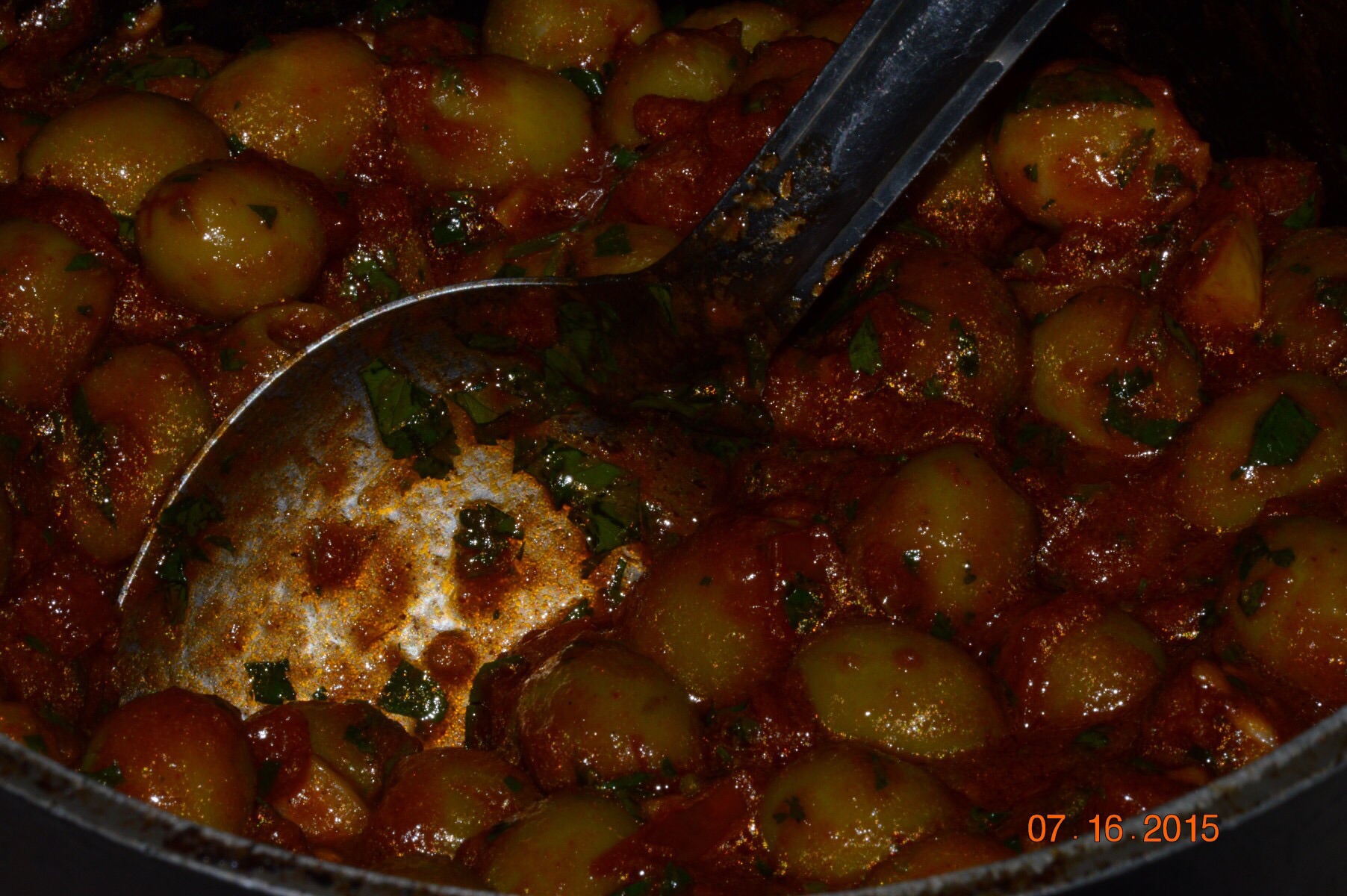
Spicy Olive Salad – stirring olives into the sauce
Instructions
Wash lemon, slice the half you’re using into about 6 slices, quarter the slices.
Heat olive oil in a saucepan.
Sauté minced garlic lightly in oil.
Stir in tomato paste & diced tomatoes and stir ’til mixed.
Add lemon slices and stir.
Add remaining ingredients except cilantro and olives.
Bring back to simmer, and cook until lemon quarters are tender.
Stir in chopped cilantro.
Remove from heat.
Add sauce to drained olives. Stir gently but thoroughly.
Enjoy these olives warm or cold.
For more, visit my blog, vegetatingwithleslie.org, “Like” me on FaceBook/Vegetating with Leslie or follow me on Twitter,@vegwithleslie.
FUL . . . serve it up as part of a mezze (appetizer table), as a main dish, a side dish, hot, cold . . . or for breakfast.
Ful is Arabic for fava beans (as hummus is Arabic for chickpeas). This is another popular Middle Eastern salad to serve as part of a mezze (Middle Eastern appetizer table), alongside of hummus, or all by itself. It is a street food in the Middle East and is part of breakfast in Egypt. There are many versions of this dish. This is mine:
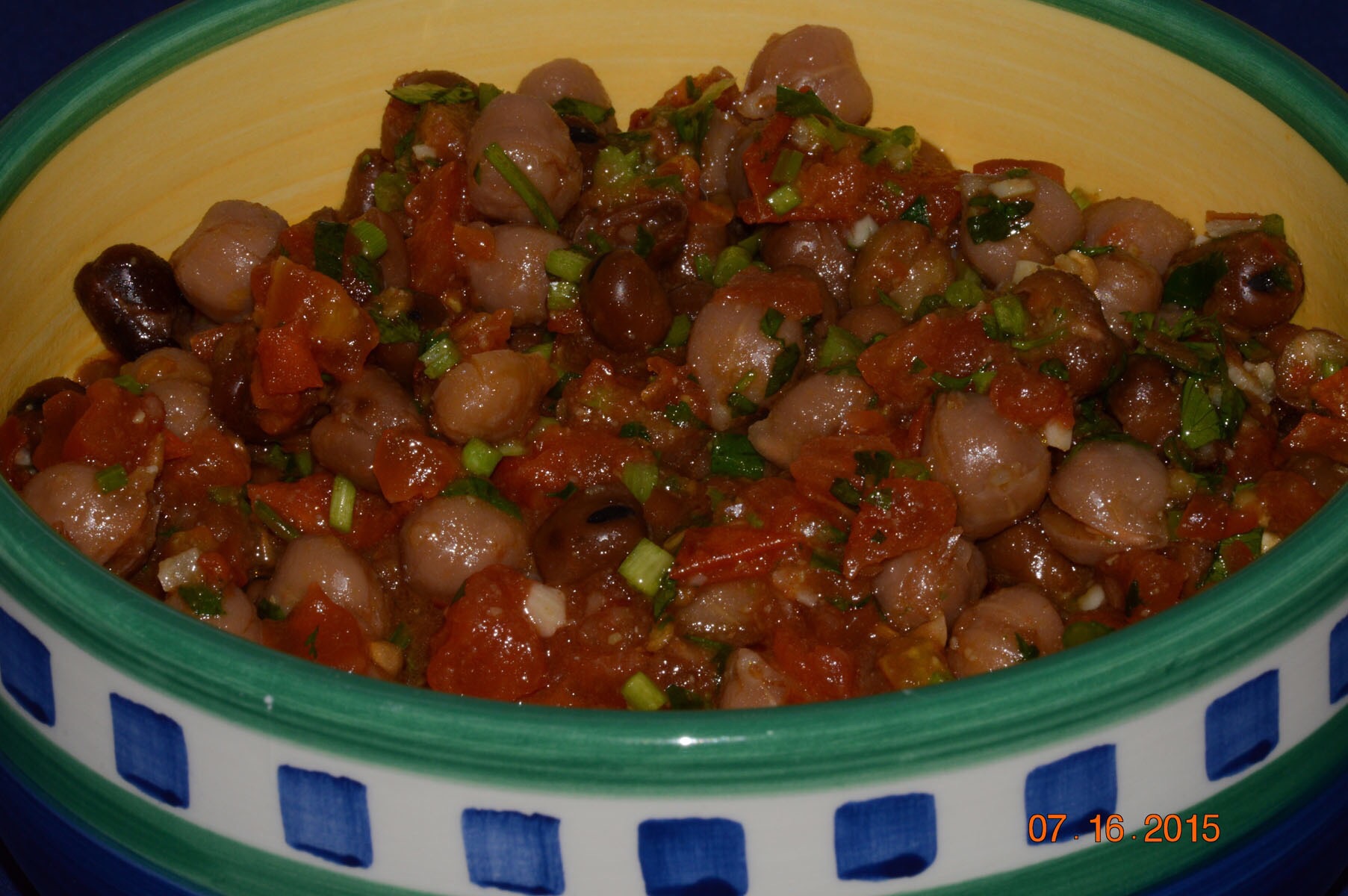
FUL in the making
FUL
Ingredients
Fava beans, 1 lb. dried (small) beans
Chickpeas, 1/2 lb. dried
Plum Tomatoes, 6 petite diced
Garlic, 1 TB minced
Extra virgin olive oil, 1/2 cup
Lemons, juice of 2 (1/4-1/2 cup – I use closer to 1/2 cup)
Cilantro, 1/2 bunch, chopped
Salt, 1 TB (scant)
Cumin, 1-1/2 TB
Red pepper, crushed, 4 tsp. (scant)
Instructions
Rinse small fava beans and chickpeas, place together in a pot to cook, and add water 1-2″ over the top of the beans.
Bring to a boil, reduce heat and simmer until done, 1-2 hours.
While the fava beans and chickpeas are cooking, prepare the sauce.
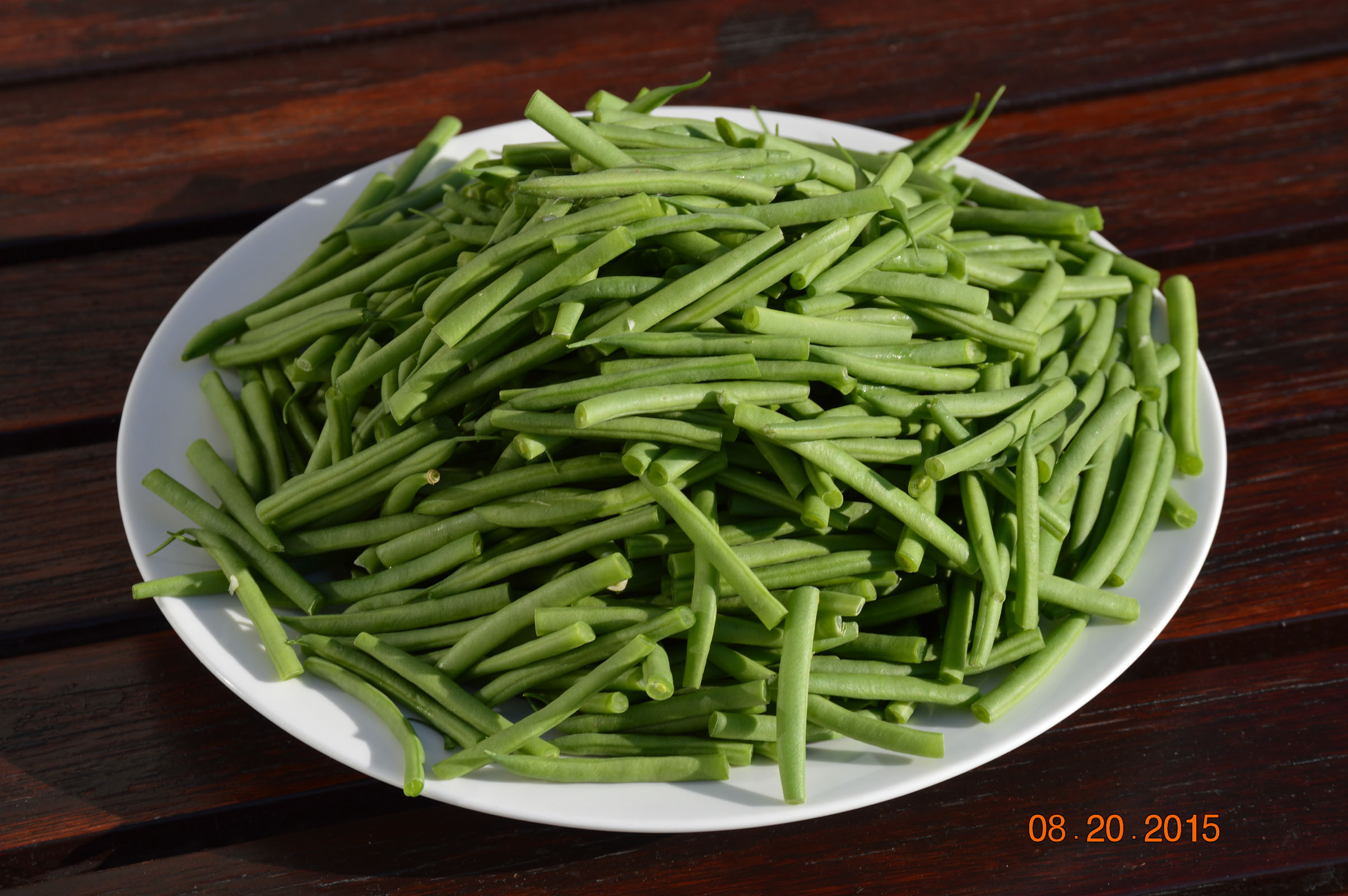
Petite dice the tomatoes. Cut the green beans as shown in the picture. Mince the garlic. Squeeze the lemons. Chop the cilantro.
Add the extra virgin olive oil to a pan with the minced garlic and allow garlic to simmer for a moment.
Add petite diced tomatoes and remaining seasonings except cilantro.
Stir and simmer tomatoes and seasonings for a few moments until mixture is saucy. Turn off the heat.
When sauce mixture is cooled, add cilantro.
When beans are cooked and well-drained, place in a bowl or back in pot, and add sauce.
Ful can be served warm or cold. I prefer it warm.
For more, visit my blog, vegetatingwithleslie.org, “Like” me on FaceBook/Vegetating with Leslie or follow me on Twitter,@vegwithleslie.